HOW TO SET UP FOREIGN-INVESTED MEDICAL FACILITIES IN VIETNAM
Healthcare is a premier sector for FDI in Vietnam, consistently ranking among the top industries for high-value M&A deals. The sector demonstrates steady, sustainable growth, making it a standout in the country’s investment landscape. However, as a highly regulated sector, it demands strict compliance with rigorous standards to ensure legal certainty and operational excellence. Navigating the setup process, therefore, presents significant hurdles for foreign investors.
In this article, Hung Phi Law Firm guides foreign investors on How to set up foreign-invested medical facilities in Vietnam, helping them streamline procedures and mitigate potential legal risks.
1. Requirements for establishing foreign-invested medical facilities
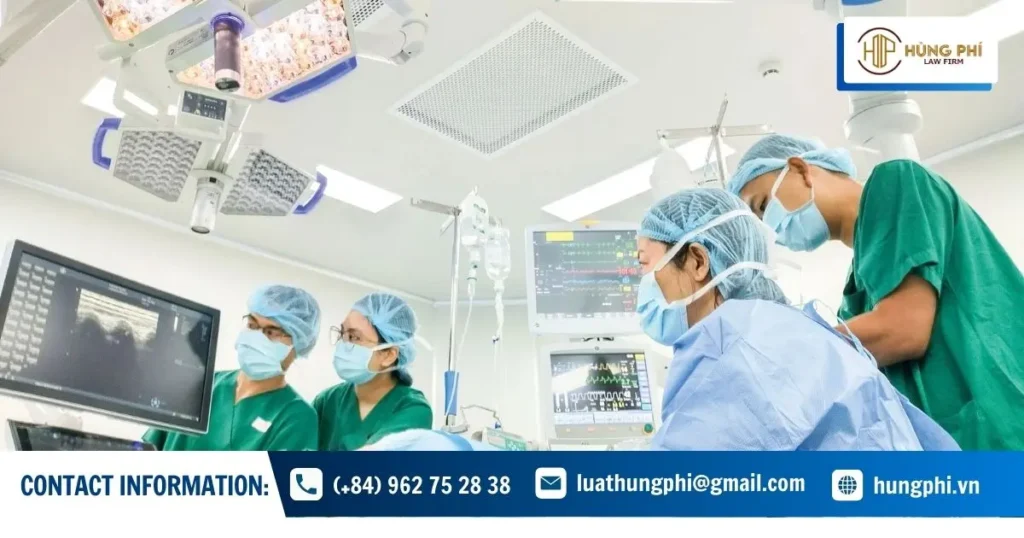 Establishment conditions for foreign-invested medical facilities
Under Decree 31/2021/ND-CP, healthcare services are not on the list of sectors Not Yet Open to Market Access for foreign investors, paving the way for international investors to set up and operate medical facilities in Vietnam’s medical market.
However, under the Vietnamese Law on Investment 2025, healthcare services are classified as a conditional business line and are subject to market access conditions applied to foreign investors. This requires foreign investors to satisfy specific statutory requirements before commencing any investment activities, specifically:
1.1. Market access conditions for medical examination and treatment services
Vietnamese law prescribes specific requirements for the minimum investment capital applicable to foreign investors in the medical examination and treatment service sector. Specifically, the capital thresholds are as follows:
– Hospital: 20 million USD.
– Policlinic: 2 million USD.
– Specialized treatment facility: 200,000 USD.
Regarding the forms of investment, foreign investors may establish a commercial presence through:
– 100% foreign-owned hospitals (or medical facilities).
– Joint ventures with Vietnamese partners.
– Business Cooperation Contracts (BCC).
– Contributing capital and purchasing shares or stakes in licensed healthcare entities in Vietnam.
1.2. General conditions for medical examination and treatment services
Under Clause 2, Article 52 of the Law on Medical Examination and Treatment 2023, the conditions for granting an operating license to a healthcare facility include:
– Legal establishment: The facility must be legally established in accordance with the law.
– Appropriate organizational structure: The organizational structure must align with the specific form of the healthcare facility.
– Fixed operating location: The facility must have a designated location for its operations.
– Adequate infrastructure & IT connectivity: Physical facilities must be suitable for the scope of professional activities and the scale of the facility. Notably, the IT infrastructure must ensure seamless connectivity with the National Medical Management Information System, as prescribed under Clause 1, Article 112 of the Law on Medical Examination and Treatment 2023.
– Medical equipment & supplies: The facility must be equipped with sufficient medical devices and instruments appropriate to its professional scope and scale.
– Qualified personnel: The facility must have adequate practitioners suitable for its scope and scale. Specifically, it must appoint a Head of Professional Expertise (Person in Charge of Professional Expertise), and each facility is permitted to have only one person in this role.
>>SEE ALSO:
MARKET ACCESS CONDITIONS FOR FOREIGN INVESTORS IN VIETNAM (2026 UPDATE)
2. How to set up foreign-invested medical facilities in Vietnam

Step-by-step setup for foreign-invested medical facilities
Due to stringent requirements regarding personnel, medical equipment, and specialized infrastructure, the establishment of foreign-invested medical facilities involves a multi-stage process, detailed as follows:
2.1. Obtaining the investment registration certificate (IRC)
To establish a foreign-invested medical facility in Vietnam, the investor must first obtain an Investment Registration Certificate (IRC).
According to Clause 11, Article 3 of the Vietnamese Law on Investment 2025, an Investment Registration Certificate (IRC) is defined as a paper or electronic document recording the registration details of an investor concerning an investment project.
The primary purposes of this certificate are to legitimize the investment project, provide the legal basis for company incorporation, and serve as the official record for tax incentives.
>>SEE ALSO:
INVESTMENT REGISTRATION CERTIFICATE (IRC) APPLICATION PROCEDURE IN VIETNAM
2.2. Obtaining the enterprise registration certificate (ERC)
This procedure is carried out to fulfill these purposes:
– Establish legal status: The ERC officially grants the project a legal entity status (a company), giving it a separate identity to exercise rights and fulfill obligations under Vietnamese law.
– Set up operational foundation: It serves as the basis for the entity to obtain its Tax Identification Number, create an official corporate seal, and open bank accounts for daily operations.
– Prerequisite for professional licensing: The ERC is a compulsory document required to apply for the Operating License, which is the final step before the facility can legally provide medical services.
>>SEE ALSO:
ENTERPRISE REGISTRATION CERTIFICATE (ERC) IN VIETNAM – PROCEDURES FOR FOREIGN INVESTORS
2.3. Obtaining the operating license for the foreign-invested medical facility
This enables the foreign-invested medical facility to legally provide medical examination and treatment services to patients, certifying that the facility has fully met the Ministry of Health’s stringent standards regarding specialized medical equipment, qualified healthcare personnel (possessing valid Practicing Certificates), and technical infrastructure safety.
Without this license, the entity exists only as a business and cannot perform any clinical activities.
Below are key steps for securing operating licenses for foreign-invested medical facilities:
Step 1: Preparing and submitting the dossier
Pursuant to Clause 1, Article 60 of Decree 96/2023/ND-CP, an application dossier for an operating license for a foreign-invested healthcare facility must include:
– Application form: A formal request for the issuance of an operating license.
– Proof of legal entity: A certified copy of the establishment decision or a document issued by a competent state authority certifying the name of the medical examination and treatment establishment (for state-owned establishments); or the Enterprise Registration Certificate (for private establishments); or the Investment Registration Certificate (IRC) for the foreign-invested facility.
– Key personnel licensing documents: A valid copy of the practitioner license and the confirmation of practice process of the person in charge of professional and technical matters and the head of the professional department of the medical examination and treatment facility;
Note: This requirement is not applicable in cases where these documents have been integrated or shared on the Medical Management Information System or the National Health Database.
– Technical declarations & supporting documents: A detailed declaration of physical infrastructure, medical equipment lists, and personnel lists that meet the licensing conditions for the specific form of organization, accompanied by supporting evidentiary documents.
– Practitioner registration list: A list specifying the full name and practitioner license number of each practitioner registered to practice at the facility.
– Organizational and operational legal documents: Documents approved by competent authorities stipulating the functions, duties, and organizational structure of state-owned hospitals, or the Charter of Organization and Operation for private hospitals.
– Proposed technical portfolio: A list of professional and technical categories proposed by the facility, developed based on the standard portfolio issued by the Ministry of Health.
Important note: In the event of an initial application for an operating license for a humanitarian or non-profit medical examination and treatment establishment, documents proving the financial resources to guarantee such humanitarian or non-profit medical activities must be provided.
Step 2: Receiving and processing the dossier
Upon receipt of the dossier, the authority shall issue a dossier reception slip to the applicant.
Pursuant to Point a and b, Clause 3, Article 61 of Decree 96/2023/ND-CP, in cases where no modifications or supplements to the dossier are required:
– On-site assessment: The licensing authority shall organize an on-site assessment of the operating conditions and the technical portfolio at the requesting facility, and shall prepare an assessment minutes within 60 days from the date recorded on the Acknowledgment of Dossier Receipt.
– Issuance of license: If no further corrections are needed, the licensing authority must issue the operating license and approve the technical portfolio within 10 working days from the date the assessment minutes are issued.
Pursuant to Clause 4, Article 61 of Decree 96/2023/ND-CP, in cases where modifications or supplements are required:
– Notification of requirements:
- Any requirements for modifications or supplements must be clearly specified in the assessment minutes.
- The licensing authority shall issue a written notice to the applicant specifying the documents and contents that require amendment or supplementation within 10 days from the date recorded on the dossier reception slip.
– Response and verification:
- Upon completing the amendments or supplementations, the applicant shall submit a written notification along with supporting documents to certify that the requested modifications have been fulfilled.
- Within 10 working days from the date of receiving the applicant’s written notice and supporting documents confirming that all rectifications or repairs have been completed, the licensing authority may, if necessary, conduct a physical inspection of the facility’s improvements or proceed to issue the operating license.
- If no further amendments are required, the licensing authority shall issue the operating license.
>>SEE ALSO:
TAX INCENTIVES AVAILABLE TO FOREIGN INVESTORS IN VIETNAM
3. Key considerations for establishing foreign-invested medical facilities

Establishing foreign-invested medical facilities: Key notes
a. Licensing process: To establish a foreign-invested medical facility, investors must strictly adhere to a multi-stage licensing process. This includes securing an Investment Registration Certificate (IRC), completing Enterprise Registration (ERC) (applicable where the investment is conducted through the incorporation of a business entity), and ultimately obtaining a specialized Medical Operating License from the competent authorities.
b. Operational compliance: As an essential public service, the establishment and operation of medical facilities are subject to strict legal compliance at every stage, from initial setup to daily operations. This includes meeting minimum investment capital, infrastructure and equipment standards, and the approved professional scope of practice.
c. Personnel qualifications: Investors must ensure that all medical practitioners possess valid practitioner licenses. Crucially, the person in charge of professional and technical matters must satisfy specific professional experience requirements, and foreign medical professionals must obtain local licenses or recognition to practice legally in Vietnam.
d. Tax and Accounting
Medical examination and treatment services are not subject to VAT; however, many ancillary services may be taxable. Incorrect classification may result in tax reassessment, penalties, and late payment interest.
When entering into contracts with foreign organizations or individuals, foreign contractor tax (FCT) obligations may arise. In addition, misidentifying the tax residency status of foreign experts may lead to incorrect personal income tax (PIT) declarations and potential tax arrears.
Expenses lacking valid invoices or failing to meet statutory payment requirements may be disallowed for corporate income tax purposes upon finalization. Profits may only be remitted abroad after the enterprise has fully satisfied its tax obligations in Vietnam.
e. Investment in the Form of Joint Venture or BCC
In joint ventures or business cooperation contracts (BCC), disputes may arise regarding the appointment of the person in charge of professional and technical matters, the registered scope of professional practice, or the strategic direction of medical services. Failure to establish a clear governance mechanism may result in non-compliance with licensing conditions and expose the medical establishment to suspension or revocation of its operating license.
Healthcare operations typically involve significant costs related to medical equipment, professional personnel, and professional liability insurance. If the joint venture agreement or BCC does not clearly stipulate cost allocation, profit distribution, and additional capital contribution obligations for expansion, financial conflicts are likely to occur.
In the event of complaints, compensation claims, or medical incidents, the absence of clearly defined liabilities among the parties in a joint venture or BCC may lead to serious disputes, directly affecting the reputation and legal standing of the medical establishment. Such sector-specific risks should be carefully addressed at the contract drafting stage.
If you are planning to invest in Vietnam’s healthcare sector, early legal planning is crucial to avoid delays and compliance risks. Hung Phi Law Firm provides end-to-end advisory services to ensure a smooth and compliant investment process.
>>SEE ALSO:
EXPERT LAWYERS FOR BCC ADVISORY AND DRAFTING IN VIETNAM
PROFESSIONAL LEGAL SERVICES FOR FOREIGN INVESTORS’ CAPITAL TRANSFER IN VIETNAM
4. Hung Phi Law Firm – a trusted law firm advising foreign investors in Vietnam’s medical sector

End-to-end legal support for foreign investors in medical field
Hung Phi Law Firm is a trusted full-service law firm with a core specialization in foreign investment. Through this practice, we assist clients navigate the complexities of Vietnam’s medical sector, frequently advising and assisting investors in establishing foreign-invested medical facilities. Our attorneys leverage deep local insights and extensive practical experience to deliver strategic legal solutions throughout the investment process in Vietnam.
Below are the prominent foreign investment legal services in medical field that Hung Phi Law Firm frequently consults on and executes:
– Strategic advice on investment processes, conditions, forms, and structures;
– Advice on tax incentives and preferential treatments for medical projects;
– Guidance on market access conditions and general regulatory requirements for medical examination and treatment services;
– Providing licensing support, including the preparation and submission of application dossiers for the Investment Registration Certificate (IRC) and Enterprise Registration Certificate (ERC);
– Advice on the establishment of foreign-invested medical facilities, including setting up foreign-owned hospitals (or medical facilities), joint ventures or Business Cooperation Contracts (BCC);
– Advice on M&A services, including capital contributions and the purchase of shares/stakes in existing licensed medical facilities in Vietnam;
– Guidance on post-licensing procedures, such as amendments to Investment Registration Certificates;
– Advice on restructuring, including the partial or full transfer of existing foreign-invested medical facilities;
– Regular legal advice on taxation, labor and employment, foreign exchange, investment reporting, and commercial contracts;
– Advice on dispute resolution, handling investment and commercial disputes arising during the operation of medical facilities.
>>SEE ALSO:
Vietnam’s Reliable Law Firm for Foreign Businesses
5. Frequently asked questions
5.1. I am a Canadian investor and have already established a licensed medical facility in Vietnam. If I open an additional clinic, do I need to apply for a new operating license?
Yes, according to Clause 1, Article 50 of the Law on Medical Examination and Treatment 2023, each medical examination and treatment establishment shall be granted one operating license with no expiration date. In the event that a medical establishment opens additional facilities at other locations, each facility must obtain a separate operating license.
5.2. What are the requirements for amending the professional scope and operational scale of a licensed medical facility?
Pursuant to Points a and b, Clause 1, Article 54 of the Law on Medical Examination and Treatment 2023, in the event of a change in the scope of professional activities or a change in the scale of operations, you are required to carry out the procedures for the adjustment of your operating license.
5.3. What criteria must be met to adjust the operating license?
Pursuant to Clause 2, Article 54 of the Law on Medical Examination and Treatment 2023, the conditions for adjusting an operating license include:
a) Having a valid operating license;
b) Meeting the conditions corresponding to the proposed adjustments in accordance with the provisions of the law.
5.4. Does Hung Phi Law Firm offer online consultation services?
Yes. We provide online legal advice via phone, email, Zalo, or WhatsApp,…. Our experienced lawyers offer flexible scheduling to ensure the most effective results and service quality for every client.
5.5. How should I prepare for a legal consultation?
You only need to provide a brief overview of your legal matter via phone, email, or our online form. After that, Hung Phi Law Firm will assign a specialist and contact you shortly to schedule a detailed consultation.
The above information outlines How to set up foreign-invested medical facilities in Vietnam, as provided by Hung Phi Law Firm to our clients.
Should you have any questions regarding this matter or require legal advice tailored to your specific case, please do not hesitate to contact the lawyers of Hung Phi Law Firm for timely support and professional consultation.
Contact Information:
Hung Phi Law Firm
Phone: (+84) 962 75 28 38
Email: luathungphi@gmail.com
Website: hungphi.vn
Sincerely,


HUNG PHI LAW - Comprehensive legal advice


Latest news

NAVIGATING FOREIGN INVESTMENT IN VIETNAM’S FINTECH AND PAYMENT INTERMEDIARIES
Mục lục1. Requirements for establishing foreign-invested medical facilities1.1. Market access conditions for medical examination and treatment services1.2. General conditions for medical examination and treatment services2. How to set up foreign-invested medical facilities in Vietnam2.1. Obtaining the investment registration certificate (IRC)2.2. Obtaining the enterprise registration certificate (ERC)2.3. Obtaining the operating license for the foreign-invested medical facility3. Key...
Read more
INVESTMENT CONDITIONS FOR FOREIGN INVESTORS ENTERING THE VIETNAMESE E-COMMERCE MARKET
Mục lục1. Requirements for establishing foreign-invested medical facilities1.1. Market access conditions for medical examination and treatment services1.2. General conditions for medical examination and treatment services2. How to set up foreign-invested medical facilities in Vietnam2.1. Obtaining the investment registration certificate (IRC)2.2. Obtaining the enterprise registration certificate (ERC)2.3. Obtaining the operating license for the foreign-invested medical facility3. Key...
Read more
LOGISTICS INVESTMENT CONDITIONS IN VIETNAM FOR FOREIGN INVESTORS
Mục lục1. Requirements for establishing foreign-invested medical facilities1.1. Market access conditions for medical examination and treatment services1.2. General conditions for medical examination and treatment services2. How to set up foreign-invested medical facilities in Vietnam2.1. Obtaining the investment registration certificate (IRC)2.2. Obtaining the enterprise registration certificate (ERC)2.3. Obtaining the operating license for the foreign-invested medical facility3. Key...
Read more
HOW TO SET UP FOREIGN-INVESTED MEDICAL FACILITIES IN VIETNAM
Mục lục1. Requirements for establishing foreign-invested medical facilities1.1. Market access conditions for medical examination and treatment services1.2. General conditions for medical examination and treatment services2. How to set up foreign-invested medical facilities in Vietnam2.1. Obtaining the investment registration certificate (IRC)2.2. Obtaining the enterprise registration certificate (ERC)2.3. Obtaining the operating license for the foreign-invested medical facility3. Key...
Read moreMost viewd news




Video of land law advice